Business · 10 min read
How to Price Handmade Furniture Without Underselling Yourself
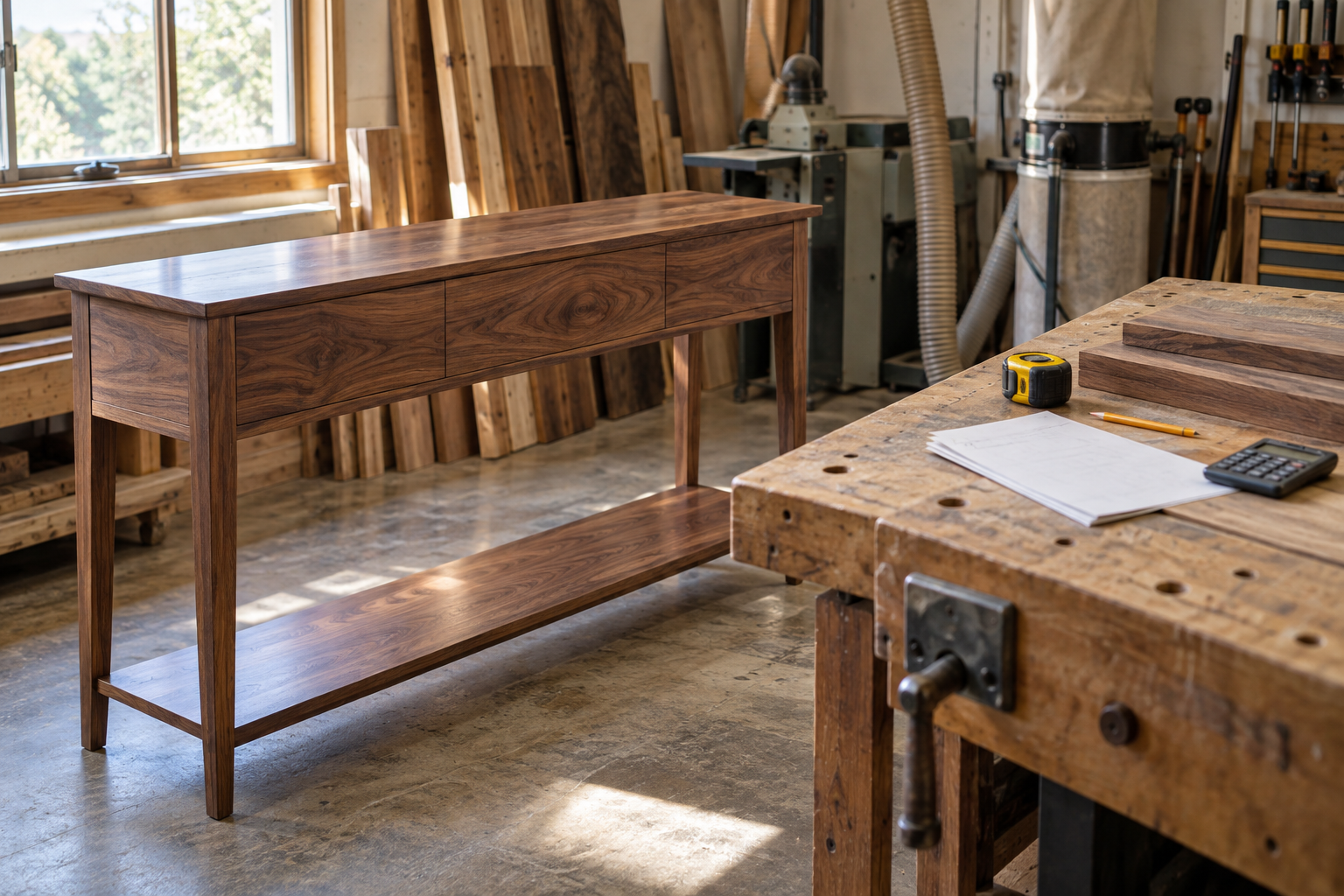
Price handmade furniture by adding materials, paid labor, and allocated shop overhead, then setting a selling price that covers transaction fees and your target profit margin. Your labor pays you for doing the work; profit is what remains after those costs. Check that price against comparable furniture, but don’t use someone else’s listing to decide what your time is worth.
The handmade furniture pricing formula
For a project sold directly to a customer, use:
Selling price = total project cost ÷ (1 − target profit margin − selling-fee rate)
Total project cost includes:
- Materials, hardware, and project-specific consumables
- All project labor, including planning and purchasing
- An appropriate share of shop overhead
- Packaging, delivery, or installation if included in the quote
Enter percentages as decimals. A 20% profit margin is 0.20; a 3% selling fee is 0.03. Add any fixed transaction charge to project cost before dividing.
This formula assumes percentage fees apply to the selling price before sales tax. Some payment services also charge fees on tax and shipping, so check your actual fee schedule.
The Woodworking Project Pricing Calculator can help organize the estimate. The important work happens before calculation: capturing costs you would otherwise forget.
Count the lumber you buy, not just the lumber in the furniture
A finished table contains less wood than you purchased. Checks, sapwood restrictions, knots, grain matching, milling, and offcuts all affect yield.
Suppose your cut list requires 18 board feet on a purchase-thickness basis. At an estimated 70% usable yield:
18 ÷ 0.70 = 25.7 board feet to purchase
Round that to 26 board feet, then check whether available board lengths and widths actually fit your parts. A single yield percentage cannot tell you whether you can get four matching legs from the stock on the rack.
Use the Board Foot & Lumber Cost Calculator to check quantities and costs. For a furniture job, keep a separate allowance for appearance requirements rather than assuming every sound offcut is useful.
As a rough planning allowance, adding 20–35% to a straightforward cut list may work for clean stock and flexible layouts. Wide clear panels or strict color matching can require substantially more. Adding 30% extra stock is not the same as allowing 30% loss: 70% yield requires buying about 43% more than the net requirement.
Include the small purchases
Charge for drawer slides, pulls, leveling feet, fasteners, abrasives, glue, finish, applicators, and packaging. Estimate partial-container consumption instead of charging every customer for a whole can of finish.
For an unusual finish you probably won’t reuse, purchasing the entire container may be a legitimate project cost. Make that decision deliberately.
All dollar figures below are illustrative US estimates, not supplier quotes. For initial budgeting, retail hardwood might run roughly $5–$18 per board foot depending on species, grade, thickness, and location; specialty stock can cost considerably more. Get current prices before sending a firm quote.
Set a labor rate that pays for your working year
Don’t divide your desired annual pay by 2,080 hours unless every working hour can actually be charged to customer projects. Marketing, bookkeeping, maintenance, quoting unsuccessful jobs, and downtime still occupy the calendar.
Start with realistic project hours:
- Desired annual owner compensation: $54,000
- Recoverable project hours: 1,200 per year
- Base labor rate: $54,000 ÷ 1,200 = $45 per hour
That assumes 25 project hours a week for 48 weeks. It is an example, not a recommended wage or guaranteed workload. Your compensation target should account for your circumstances, including benefits and taxes that employment might otherwise cover. Discuss the accounting treatment with your accountant.
The Woodworker Hourly Rate Calculator is useful for testing different workloads. A rate that works at 1,200 hours may fail badly at 700.
Track more than machine time
Project labor includes drawings, customer-specific revisions, material pickup, stock selection, milling, joinery, assembly, sanding, finish application, inspection, and packing.
Drying time is different. Eight hours of unattended finish drying is not eight hours of labor. However, a large piece occupying your only finishing area can limit capacity; that burden belongs in overhead or a clearly justified space charge.
Separate general sales activity from project-specific work. Don’t charge the same time directly to a customer and again through overhead.
For unfamiliar construction, make a sample joint or prototype and estimate honestly. Customers shouldn’t unknowingly fund unlimited practice, but you shouldn’t erase legitimate development work from the quote either.
Recover shop overhead without counting it twice
Overhead includes expenses that support the business rather than one particular piece:
- Rent or a reasonable business-use share of shop space
- Insurance, licenses, software, and bookkeeping
- Utilities and dust collection operation
- Routine machine maintenance and sharpening
- Tool depreciation or an equipment-replacement allowance
Suppose annual overhead is $18,000 and you expect 1,200 project hours:
$18,000 ÷ 1,200 = $15 overhead per project hour
Combined with the $45 labor rate, that is a $60 hourly cost before profit. You can show labor and overhead separately in your internal estimate or combine them into one shop rate. Don’t do both.
A paid-off table saw still wears out. A garage shop still consumes space and electricity. Low overhead is an advantage, not a reason to pretend overhead is zero.
Safety belongs in the budget, too. Allow for dust extraction, appropriate protective equipment, and safe material handling. Follow finish-label instructions for ventilation and oily-rag disposal. A low quote is never a reason to skip safe procedures.
Worked example: pricing a handmade walnut console table
Consider a walnut console measuring 48 × 14 × 30 inches (1,219 × 356 × 762 mm), with a simple base and no drawers. This example assumes a local pickup sale, not freight delivery or installation.
Estimated hands-on time:
- Drawing, customer coordination, and purchasing: 1.5 hours
- Stock selection and milling: 2 hours
- Joinery and fitting: 4 hours
- Glue-up and assembly: 2 hours
- Sanding and surface preparation: 3 hours
- Finish application and between-coat work: 2 hours
- Inspection and packing: 1.5 hours
Total: 16 hours. Your first version may take longer; use your own records when available.
| Cost category | Estimate basis | Amount |
|---|---|---|
| Walnut | 26 board feet at $12 | $312 |
| Hardware | Fasteners, tabletop attachments, levelers | $38 |
| Finish and consumables | Finish, abrasives, glue, applicators | $55 |
| Packaging | Protective wrap and corner protection | $25 |
| Labor | 16 hours at $45 | $720 |
| Shop overhead | 16 hours at $15 | $240 |
| Total project cost | Before selling fees and profit | $1,390 |
For a 20% target profit margin and an assumed 3% payment fee:
$1,390 ÷ (1 − 0.20 − 0.03) = $1,805.19
Round the quote to $1,810 before applicable sales tax. At that price, the assumed fee is $54.30 and estimated operating profit is $365.70, about 20.2% of the sale.
That profit is separate from the $720 already allocated to your labor. It provides a return on the business and helps absorb risk; it is not automatically spendable personal income.
If actual labor reaches 20 hours, another $240 of labor and overhead consumes most of that profit. Tracking time is what makes the next quote better.
Markup versus margin: why adding 20% falls short
Markup measures profit relative to cost. Margin measures profit relative to selling price. They are not interchangeable.
With a $1,000 project cost and no selling fees:
| Pricing method | Selling price | Profit | Profit margin |
|---|---|---|---|
| Add 20% markup | $1,200 | $200 | 16.7% |
| Add 25% markup | $1,250 | $250 | 20% |
| Target 30% margin | $1,428.57 | $428.57 | 30% |
Use the Markup & Margin Calculator when checking a quote or evaluating a discount.
Sales channels also change the math. If a gallery hypothetically retains 40% of the retail price and you want a 20% margin on that retail price, only 40% remains to cover project costs. The $1,390 console would need a $3,475 retail price under those assumptions, before any other charges.
Get the actual commission terms. Don’t assume your direct-sale price works through a gallery or marketplace.
Check the market without copying the cheapest listing
Compare five to ten genuinely similar pieces. Match dimensions, wood species, construction, customization, finish quality, delivery, and seller reputation. A factory-made veneered console is not a direct comparison for a custom solid-walnut piece.
Asking prices are evidence of positioning, not proof that furniture sells at those prices. Customer inquiries, accepted quotes, and repeat orders are stronger feedback.
If your calculated price is above what your customers will pay, change something measurable:
- Offer standard sizes instead of unlimited customization.
- Simplify labor-heavy details.
- Batch compatible parts or repeat builds.
- Offer a less expensive species with a fresh cost estimate.
- Charge separately for delivery and installation.
- Seek customers who specifically value your work.
Lowering price without lowering cost simply transfers money from your pocket to the buyer. If the job cannot support your required rate, declining it may be the soundest business decision.
Write a furniture quote that protects the price
A clear quote should specify:
- Dimensions, species, and approved design or drawing
- Finish appearance and any sample-approval process
- Included hardware and customization
- Price, applicable tax, and delivery or installation charges
- Payment schedule and estimated completion window
- Quote expiration date
- How changes, cancellations, and storage delays are handled
A 50% deposit on the example table would be $905. Set deposits around committed materials, scheduled work, and local legal requirements—not merely habit. Explain cancellation terms rather than assuming every deposit can legally be nonrefundable.
Require written approval and a price adjustment before changing dimensions, adding drawers, or switching finishes. Define what makes final payment due, such as inspection and acceptance before pickup.
For delivery, account for round-trip driving, loading, unloading, vehicle costs, stairs, and a helper when needed. A narrow hallway or second-floor installation is scope, not a surprise favor.
Common mistakes when pricing handmade furniture
- Using “materials times three.” It cannot reliably distinguish a quick bench from a labor-heavy cabinet using similar lumber quantities.
- Treating owner labor as profit. A business that only reimburses materials and pays wages has no remaining business profit.
- Giving away discounts. A 10% discount on the $1,810 console removes $181 of revenue while barely changing its costs.
- Pricing from memory. Record estimated and actual hours by task, plus purchases and rework.
- Counting reusable offcuts as cash recovered. They reduce a future purchase only when you actually use them.
- Padding every category blindly. Use a specific allowance for identifiable uncertainty rather than hiding several overlapping cushions.
- Forgetting taxes. Collected sales tax is not revenue; income-tax obligations also need planning. Rules vary by location.
FAQ
What hourly rate should I charge for woodworking?
Calculate it from your compensation goal, realistic project hours, and overhead. The example uses $45 for labor plus $15 for overhead, or $60 per project hour before profit and fees. Your sustainable rate may be substantially different.
What is a good profit margin for handmade furniture?
There is no universal percentage. Test several targets, such as 15%, 20%, and 25%, after paying labor and overhead. These are planning scenarios, not industry benchmarks. Custom one-off work with uncertain labor needs more risk allowance than a proven repeat design.
Should I charge less because I’m a beginner?
Reduce scope before reducing your rate. Offer simpler pieces you can build safely and consistently. Track learning time separately, and don’t promise professional-level work you cannot yet deliver. Any introductory discount should be explicit and limited.
Should I publish furniture prices or quote every project?
Publish prices for standardized pieces and quote substantial customization separately. A starting price works only when you clearly describe what it includes. Specify size, species, hardware, and whether delivery is extra so customers can budget realistically.
How often should I update my furniture prices?
Check material and outside-service costs before each custom quote. Review labor estimates after every completed job, and revisit overhead and annual project-hour assumptions at least annually—or sooner when rent, workload, or equipment costs change.
What should I read next?
Recommended tools
Digital Angle Gauge
Dial your blade in to 0.1°
View on Amazon →
Laser Tape Measure
Measure long spans solo, fast
View on Amazon →
Titebond III Wood Glue
Waterproof and stronger than the wood
View on Amazon →
As an Amazon Associate we earn from qualifying purchases.
Need ready-to-build plans?
5 complete build plans with cut lists — $14.