Joinery · 10 min read
Pocket Holes vs. Dowels vs. Biscuits: Which Joint Holds Up?
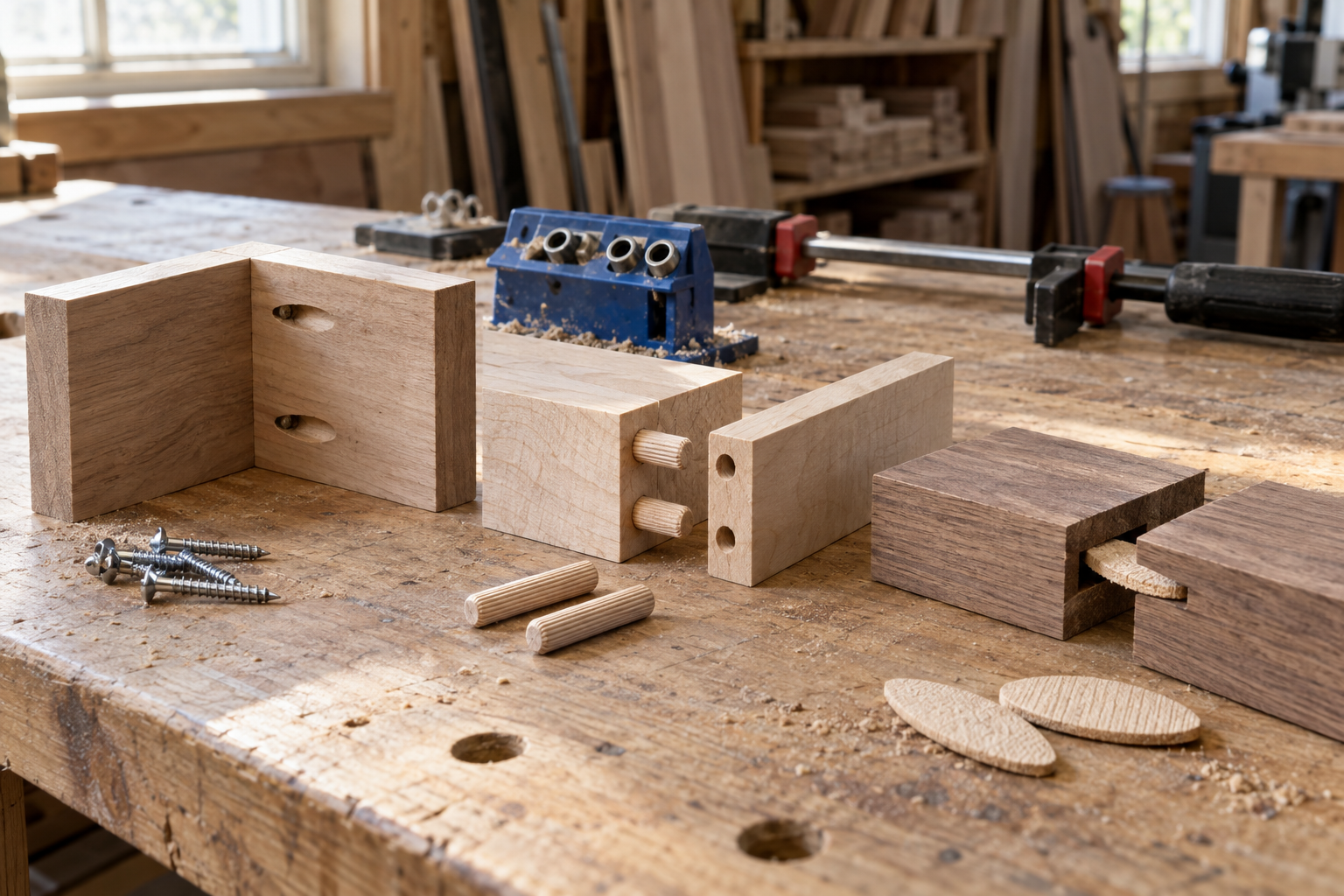
Pocket holes are usually the fastest choice for cabinet assembly, properly fitted dowels are generally the better choice for concealed joints that must resist repeated racking, and biscuits are most useful for alignment. There is no universal strength winner: joint geometry, material, glue fit, and load direction matter more than the name of the fastener.
Pocket holes vs. dowels vs. biscuits at a glance
Think about what the connection must prevent: sliding, pulling apart, or rotating. A joint can resist one well and still fail when somebody leans against the finished piece.
| Consideration | Pocket holes | Dowels | Biscuits |
|---|---|---|---|
| Best everyday use | Face frames, cabinet assembly, hidden attachments | Concealed frame joints and reinforced butt joints | Panel alignment and some cabinet joints |
| Main holding mechanism | Screw threads and head bearing | Glued dowels embedded in both members | Glued loose spline in matching slots |
| Assembly speed | Fast; screws hold parts immediately | Slower; accurate drilling and clamping required | Fast cutting, followed by glue-up and clamping |
| Alignment tolerance | Parts can shift while driving | Low; hole locations must match | Some adjustment along the slot |
| Appearance | Angled holes need hiding or plugging | Completely concealed | Completely concealed |
| Typical weakness | Stripped threads, splitting, joint rotation | Misaligned holes, poor glue fit, insufficient embedment | Limited reinforcement against severe prying |
| Entry-level tool budget* | $35–$150 plus drill | $30–$150 plus drill | $80–$250 for a joiner |
Prices are estimated US retail ranges, not quotes. Better fences, bushings, and registration systems can cost considerably more. Glue, clamps, bits, and consumables are additional.
What actually makes a woodworking joint strong?
Pullout strength is not racking resistance
A shelf carrying books creates different demands from a chair being dragged sideways. The shelf connection may primarily transfer downward load; the chair joint repeatedly tries to rotate open.
Racking is the sideways distortion that turns a rectangular assembly into a parallelogram. A fitted cabinet back, diagonal brace, or properly designed apron can improve the entire structure more than switching between these three joining methods.
For example, a bookcase with pocket-screwed shelves and a securely attached structural back can be a better system than one with doweled shelves but no racking restraint. The back’s thickness, fit, and attachment still matter.
Material and fit change the result
Hardwood generally gives screws better thread purchase than low-density softwood, but it is also easier to split when pilot preparation or screw placement is wrong. Plywood varies by core quality. MDF and particleboard require particular care, especially near edges.
Dowels and biscuits depend on sound material around their holes or slots. Neither can restore strength to a void-filled plywood edge or a crumbling particleboard corner.
Glue also needs close-fitting surfaces. Ordinary woodworking PVA is not a structural gap filler. A thick glue line does not rescue sloppy machining.
There is no honest universal answer to “How many pounds will this joint hold?” without specifying the material, geometry, fastener layout, and loading method.
Pocket-hole joints: best for fast, practical assembly
Pocket-hole screws pull one member against another through angled pilot holes. They provide immediate mechanical holding, so you can usually remove the assembly clamp after fastening. Any glue still needs its specified cure time before loading.
Their biggest advantage is workflow. A basic jig and drill can assemble a face frame without waiting for every connection to come out of clamps.
A reliable pocket-hole setup
For two pieces of actual 3/4-inch (19 mm) stock, a common starting point is a 1-1/4-inch (32 mm) pocket screw, with the jig and stop collar set for that thickness. Confirm the jig manufacturer’s chart, particularly for mixed thicknesses or unusual joint orientations. The Pocket Hole Screw Selector helps narrow the starting choice.
Use screws intended for pocket-hole joinery. Their head shape bears against the pocket shoulder; a typical countersunk screw can wedge into it and split the wood.
- Use the thread style recommended for the material—commonly coarse threads for softwood and plywood, and fine threads for hardwood.
- Clamp the mating surfaces flush before driving.
- Start with a low drill clutch setting and increase only as needed.
- On a rail wide enough to allow proper spacing, use two screws rather than one to reduce rotation.
- Test the setup in matching scraps before drilling finished parts.
Glue can supplement a tight pocket-screwed joint, but do not treat an end-grain butt connection as equivalent to a long-grain panel glue joint.
Where pocket holes hold up—and where they struggle
They are practical for face frames, built-ins, cabinet stretchers, and hidden connections in supported assemblies. Keep the pockets accessible until assembly is complete.
They are less attractive for a narrow chair rail subjected to years of sideways leverage. Screws may loosen, surrounding fibers may crush, or the joint may rotate despite initially feeling tight.
Pocket screws can sometimes be removed for repairs, but a glued connection is not truly knockdown joinery. Repeatedly removing and reinstalling screws can also degrade the wood threads.
A small box of pocket screws commonly costs about $6–$15, depending on quantity, size, and coating. That convenience is often worth more than the minor consumable savings of another method.
Dowel joints: concealed strength with less forgiveness
Dowels bridge the joint with glued wooden pins. Properly arranged, they resist separation and rotation without leaving visible fasteners.
For a concealed butt joint exposed to moderate racking, a well-made dowel connection is generally my first choice among these three. That assumes adequate member size, suitable embedment, and accurate holes—not one loose pin in an oversized hole.
Dowel size, spacing, and embedment
In 3/4-inch (19 mm) stock, 5/16-inch (8 mm) and 3/8-inch (9.5 mm) dowels are common choices. Centering a 3/8-inch (9.5 mm) hole through that thickness leaves 3/16 inch (4.8 mm) of wood on either side. That remaining wood is one reason bigger is not automatically better.
On a 2-inch-wide (51 mm) rail, two dowels with centers approximately 1/2 inch (13 mm) from the side edges provide 1 inch (25 mm) of separation. Check that this layout also leaves adequate material in the receiving member.
Embedment must suit the joint geometry. Where a rail end meets the face of a 3/4-inch-thick (19 mm) panel, you cannot drill equally deep into both pieces with a long dowel. A workable starting layout for a 1-1/2-inch (38 mm) dowel is approximately 1/2 inch (13 mm) of embedment into the panel and 1 inch (25 mm) into the rail end. Provide a little additional combined hole depth for glue and seating clearance, without approaching the panel’s outside face.
Use a positive depth stop and verify the actual drilled depth on scrap, including the drill point.
What makes dowels reliable
Reference every mating part from the same marked face. A jig centered independently on two slightly different board thicknesses can produce a visible step even when both holes appear centered.
Dry-fit first. Dowels should enter with firm hand pressure or light tapping, not require hammer blows. Use accurately sized joinery dowels; fluted or compressed designs help distribute glue and provide escape paths.
Apply glue to the hole walls and dowels, assemble promptly, and clamp the shoulders closed. Do not fill blind holes with glue: trapped glue can prevent seating and may split thin stock.
A small pack of dowels typically costs about $4–$12. The bigger investment is a jig that registers consistently—and enough clamps to keep the project moving.
Biscuit joints: excellent alignment, selective reinforcement
Biscuits are thin, compressed-wood splines fitted into curved slots. They offer some lateral adjustment along the slot while helping keep adjoining surfaces aligned.
Their strongest everyday argument is easier assembly, not replacing substantial furniture joinery.
Where biscuits earn their keep
Biscuits help align wide panel glue-ups, cabinet parts, and some miters. On a sound, well-fitted long-grain edge joint, the glue surfaces already provide the primary connection. Biscuits mainly keep the boards from skating vertically during clamping.
Common sizes are #0, #10, and #20. Choose according to the available width, thickness, and slot position—not simply the largest number. The Biscuit Size Calculator is useful for planning the fit.
For panel alignment, spacing biscuits roughly 6–10 inches (152–254 mm) apart is a practical starting point, not a structural specification. Leave enough distance from the ends that later trimming will not expose a slot.
Why biscuits are not a universal strength upgrade
A biscuit can reinforce a butt joint, but its shallow embedment and thin section limit what you should expect under heavy prying or repeated racking. Do not treat one biscuit in a narrow furniture rail as equivalent to a well-designed dowel pattern or mortise-and-tenon joint.
Slots cut from inconsistent reference faces can lock a panel into the wrong alignment. Biscuits and moisture from glue can also produce localized swelling; allow the glue-up to dry thoroughly before final flattening or sanding.
A small container of biscuits generally costs about $8–$20. If you already own a biscuit joiner, they are convenient. Buying one solely to make edge-glued panels “strong enough” usually solves the wrong problem.
Which joint should you use for your project?
Cabinet face frames and plywood boxes
Use pocket holes when speed, modest tooling cost, and hidden fasteners matter most. Use dowels when you want concealed connections and can machine repeatable locations.
For either method, design the cabinet back and shelf supports deliberately. Biscuits can help locate parts, but they should not be the automatic answer for every heavily loaded butt joint.
Bookshelves and storage units
Separate joint failure from shelf bending. A shelf can sag badly while its connections remain intact. Check span, material, thickness, and load with the Shelf Sag Calculator.
For heavy storage, consider housed joints, cleats, or other direct-bearing supports rather than asking screws, dowels, or biscuits alone to carry every load. Secure tall furniture against tipping with appropriate anchoring hardware.
Tabletops, tables, and chairs
For edge-glued tabletops, use biscuits if they simplify alignment; accurate edges and sensible clamping remain essential.
Do not rigidly fasten a solid-wood top across its grain with any of these methods. Use movement-friendly hardware or appropriately slotted attachments. Estimate seasonal change with the Wood Movement Calculator.
For table aprons and especially chairs, consider purpose-designed mortise-and-tenon or loose-tenon joinery. A properly engineered multi-dowel joint can work, but chair construction is not the place to guess from cabinet experience.
Common mistakes
- Judging strength immediately after assembly. Screws feel solid right away; glued joints need the adhesive’s specified cure time.
- Choosing larger fasteners without checking the remaining wood. Oversized holes and slots can weaken thin members.
- Using more fasteners instead of fixing the fit. Extra screws cannot square a badly cut joint without introducing stress.
- Ignoring leverage. A long leg can pry hard on a small connection.
- Skipping a full dry assembly. Confirm square, clamp access, and screw access before spreading glue.
- Machining unsupported parts. Clamp drilling work securely and support biscuit-joiner cuts. Wear eye and hearing protection, collect dust, and disconnect power before cutter changes or servicing.
FAQ
Are dowels stronger than pocket screws?
They can be, particularly in accurately fitted, glued joints designed to resist racking. But dowel diameter, spacing, embedment, and material determine the result. A poorly fitted dowel joint can perform worse than a properly made pocket-screw connection.
Do biscuits make an edge-glued panel stronger?
They can contribute locally, but a well-made long-grain glue joint generally does not need them for ordinary panel construction. Use biscuits primarily for alignment rather than as insurance against poorly prepared edges.
Can I assemble pocket-hole joints without glue?
Yes, where the design can rely on the screws alone. That may help with later disassembly. Do not assume an unglued connection will resist repeated rotation as well as a suitable glued joint.
Which method is cheapest for a beginner?
If you already own a drill, a basic pocket-hole or doweling jig usually has the lowest entry cost. Pocket holes favor speed; dowels favor concealed joinery. Compare the total cost of clamps, bits, and consumables, not just the jig.
How can I compare the joints in my own shop?
Make several matching samples using your actual stock and layout, then allow full glue cure. Secure each sample and apply load in the direction the finished project will experience. Wear eye protection and stay out of the failure path. Treat the results as a shop comparison—not a certified load rating.
What should I read next?
Recommended tools
Digital Angle Gauge
Dial your blade in to 0.1°
View on Amazon →
Laser Tape Measure
Measure long spans solo, fast
View on Amazon →
Titebond III Wood Glue
Waterproof and stronger than the wood
View on Amazon →
As an Amazon Associate we earn from qualifying purchases.
Need ready-to-build plans?
5 complete build plans with cut lists — $14.