Lumber · 10 min read
Plywood Grades Decoded: A-C, BC, and Baltic Birch
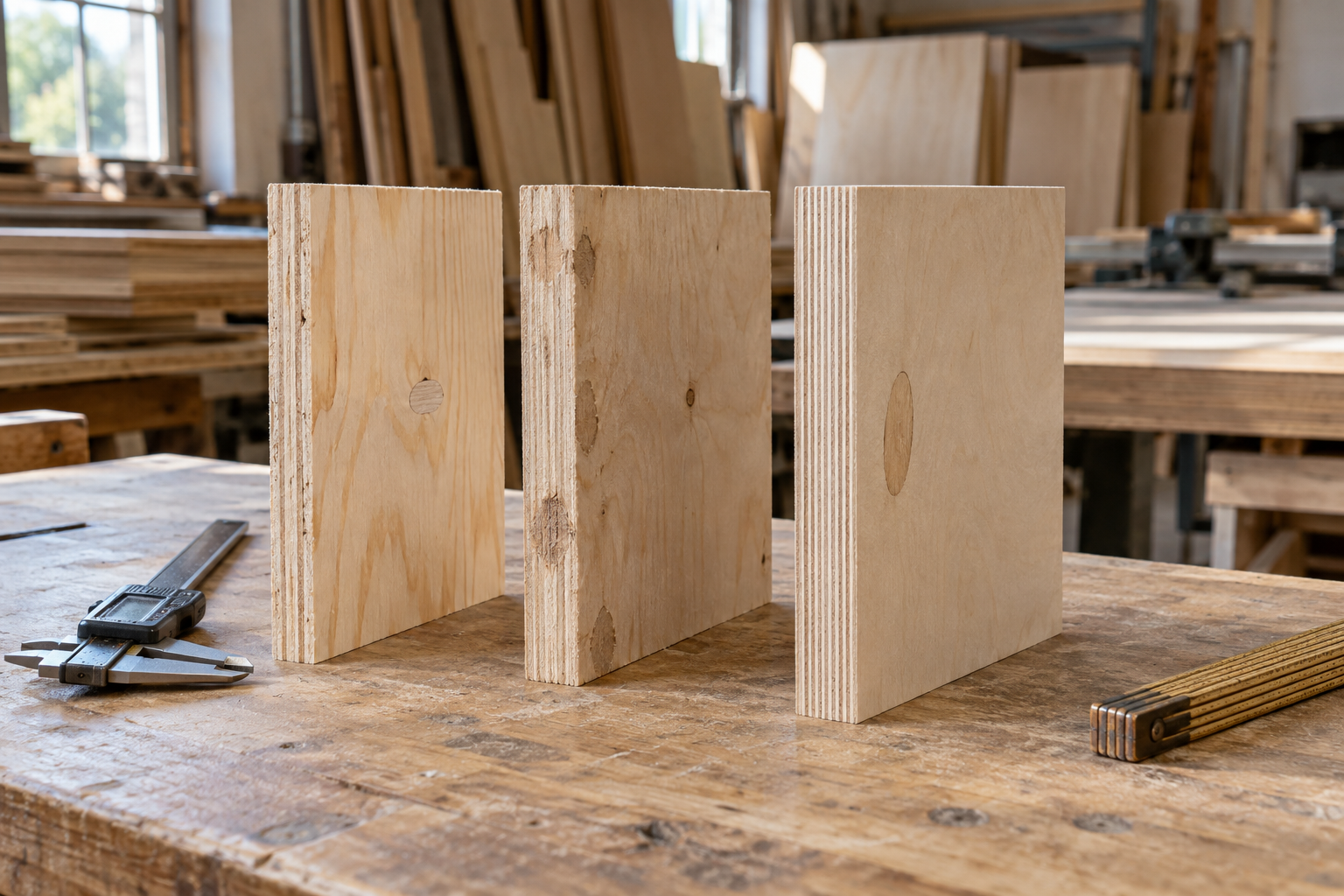
A-C and BC plywood labels describe the quality of the two outer veneers: the first letter is the better face, and the second is the back. Baltic birch describes a plywood construction and product family, not a single appearance grade. To choose the right sheet, read the face grade, inspect the core, and check the bond or exposure rating separately.
How to read plywood grades at the lumberyard
A plywood label answers several different questions, but not always in one convenient place. Before buying, identify:
- Face and back grade: How clean are the visible surfaces?
- Core construction: What sits between those surfaces?
- Bond or exposure classification: What moisture conditions can the panel tolerate?
- Thickness and dimensions: What are you actually taking home?
- Structural designation, if needed: Is the panel rated for the intended building use?
These are separate properties. A smooth A face does not prove that the core has no voids, and an exterior glue bond does not make the wood rotproof.
Also, not every plywood product uses the same grading system. A-C softwood plywood, hardwood plywood marked A-1, and Baltic birch marked BB/BB cannot be compared letter for letter.
What A, B, C, and D mean on softwood plywood
For commonly sold US softwood plywood, the letters broadly describe veneer quality:
| Veneer grade | What to expect | Practical use |
|---|---|---|
| A | Smooth, sanded veneer; sound repairs may be present | Visible painted surfaces and utility cabinetry |
| B | Solid surface with more permitted repairs and blemishes than A | Painted work where appearance is less demanding |
| C | Knots, knotholes, splits, and repairs permitted within grade limits | Concealed backs and utility surfaces |
| D | Larger or more numerous defects permitted | Concealed construction work where the panel specification allows it |
The exact limits depend on the applicable product standard. Some products carry a C-Plugged designation, which is not the same as an ordinary C veneer.
An A face is not necessarily an uninterrupted, furniture-quality grain pattern. A repaired softwood veneer can meet its grade while looking wrong under clear finish. Inspect the actual face rather than buying a letter alone.
A-C vs. BC plywood: what changes?
A-C, AC, and ACX are labels you may encounter for panels with an A face and C back; BC and BCX identify a B face and C back. Hyphens and retail naming vary, so use the panel stamp or manufacturer's specifications to confirm the product.
The practical difference between A-C and BC is usually the work needed on the better face. A-C generally offers a cleaner starting surface. BC may require more filling and sanding, and its repairs may remain noticeable through paint.
Both can work for shop cabinets, painted storage, and built-ins with concealed backs. Neither designation guarantees a uniformly attractive exposed edge.
When A-C plywood is worth the extra money
Choose A-C when one broad face will be visible and you want to reduce surface preparation. Think painted cabinet ends, utility-room shelving, or a bench enclosure.
Suppose A-C costs $15 more per sheet than comparable BC. Across three sheets, that is a $45 premium. If the BC faces need extensive patching, the cheaper plywood may not be the cheaper finished project.
Still, softwood grain can show through paint, especially across contrasting earlywood and latewood. For a smooth painted cabinet surface, compare A-C with a paint-grade hardwood plywood rather than assuming A-C is the best available finish substrate.
When BC plywood is enough
BC is often a sensible buy for concealed cabinet components, shop storage, and surfaces that will be covered. Inspect the B face for repairs that might land along a narrow part or visible edge.
For shelves, the jump from BC to A-C should not be treated as a reliable stiffness upgrade. Species, thickness, core construction, and support arrangement matter more than the appearance letters alone.
What Baltic birch plywood actually means
Traditional Baltic birch plywood uses birch veneers throughout the panel, with numerous relatively thin layers. That differs from birch-faced plywood built around mixed hardwood, softwood, MDF, or another core.
The all-birch construction usually gives you consistent machining, strong edge fastening, and attractive layered edges. It is especially useful for drawer boxes, jigs, cabinet parts, and projects where the plywood edge remains visible.
However, “Baltic birch” on a shelf tag is not a complete specification. Ask about the manufacturer, core species, face grade, thickness tolerance, and glue-bond classification. Product sourcing and availability vary, and similar-looking birch panels are not necessarily interchangeable.
Baltic birch grades such as B/BB and BB/BB
Common trade descriptions include:
- B/BB: A cleaner B face paired with a BB back that permits repairs, including patches.
- BB/BB: Both faces permit repairs and patches; often a practical choice for shop fixtures and drawer components.
- BB/CP: One BB face and a more permissive back grade, where offered.
These are shorthand descriptions, not universal defect allowances. Suppliers may reference different national standards or manufacturer specifications. Ask to see the grading sheet, especially when patch count, color variation, or clear-finish appearance matters.
A Baltic birch B face is not directly equivalent to the B face on US BC softwood plywood.
Is Baltic birch plywood void-free?
Quality Baltic birch generally has fewer and smaller internal voids than inexpensive utility plywood, but “void-free” should not be assumed without a supplier specification.
Inspect all accessible edges. Look for missing veneer, overlapping layers, open glue lines, and patches of crushed core. A clean factory edge is encouraging, but it cannot reveal every defect inside the sheet.
A typical nominal 3/4-inch-class panel sold at 18 mm—about 0.709 inch—may have 13 plies. Ply count varies, so use it as a construction clue rather than a quality guarantee.
Compare plywood types and estimated prices
These are estimated US retail ranges, not quotes. Region, supplier, thickness, sourcing, and face quality can move prices substantially. The examples below are roughly nominal 3/4-inch (19 mm) material; Baltic birch is often sold as 18 mm.
| Plywood type | Typical sheet size | Estimated price | Best reason to buy | Main caution |
|---|---|---|---|---|
| BC softwood | 48 × 96 inches (1,219 × 2,438 mm) | $40–$75 | Affordable utility work | More face preparation; inspect core |
| A-C softwood | 48 × 96 inches (1,219 × 2,438 mm) | $55–$95 | Cleaner face for painted work | Repairs and grain can remain visible |
| Birch-faced cabinet plywood | 48 × 96 inches (1,219 × 2,438 mm) | $75–$150 | Attractive faces and cabinet-friendly options | Core quality varies widely |
| Baltic birch, BB/BB | 60 × 60 inches (1,524 × 1,524 mm) | $90–$170 | Layered edges and consistent machining | Patches, availability, and higher cost |
Compare cost per usable area, not just price per sheet. A standard rectangular sheet contains 32 square feet; the square Baltic birch sheet shown above contains 25 square feet. At $110 and $100 respectively, they cost about $3.44 and $4.00 per square foot before waste.
Use the Plywood Sheet Calculator for an initial material estimate, then check whether your actual parts fit the available sheet dimensions. A lower square-foot price does not help if the layout requires an extra sheet.
Exterior plywood, Exposure 1, and the misleading X
Retail labels often use an X in names such as ACX or BCX. Do not treat that character alone as proof that a panel is appropriate for permanent outdoor exposure. Read the recognized grade stamp or product documentation.
Two classifications commonly encountered on structural panels are:
- Exposure 1: A moisture-resistant bond intended to withstand temporary wetting, such as construction delays. It is not intended for long-term weather exposure.
- Exterior: A bond classification intended for repeated wetting and drying or long-term weather exposure when the panel is properly used.
Neither classification makes untreated wood decay-resistant. Outdoor projects still need suitable detailing, drainage, protection where required, and maintenance. Paint cannot convert an unsuitable panel into exterior-rated plywood.
Baltic birch also comes with different bond specifications. Some panels are intended for dry interiors; others have moisture-resistant or exterior-rated bonds. The birch layers themselves do not settle that question.
For roof, wall, or floor sheathing, follow the required structural rating and local code—not an appearance grade or the advice that “thicker should be fine.”
Choose plywood by the part you are building
Painted cabinets and built-ins
For visible cabinet sides, prioritize face smoothness and a stable, sound core. A-C can be serviceable, but hardwood plywood with an appropriate paint-grade face may produce a cleaner result.
Where both faces show, such as a room divider or open cabinet side, buy a panel with acceptable grades on both sides. A C back does not disappear after paint.
Shelves that need to resist sag
For shelving, span and loading deserve more attention than the face letter. A nominal 3/4-inch (19 mm) shelf spanning 36 inches (914 mm) can behave very differently depending on its core, depth, load, and edge reinforcement.
Run the proposed size and loading through the Shelf Sag Calculator, using the closest appropriate material option. Treat the result as an estimate, since plywood stiffness varies. Adding a center divider or a properly attached stiffening edge can be more effective than buying prettier faces.
Drawer boxes, jigs, and exposed edges
Baltic birch earns its price when the edge matters. Its relatively uniform layers suit routed profiles, hardware mounting, and clear-finished drawer sides.
For a temporary jig with no critical edge fastening, BC may do everything you need. For a template that will see repeated use, a sound, uniform core becomes more valuable.
Inspect and measure plywood before cutting
Bring a tape measure and calipers if your joinery depends on thickness. Nominal 3/4-inch (19 mm) plywood might be 23/32 inch (18.3 mm), while a metric panel may be 18 mm (0.709 inch). Those differences are enough to spoil a fitted groove.
Before loading a sheet:
- Sight along it for bow and twist.
- Inspect both faces, not just the top sheet's best side.
- Check exposed edges for voids and separation.
- Measure thickness at several accessible points.
- Confirm dimensions, grade, and exposure markings.
Mark visible-face orientation and grain direction on your parts list. The Cut List & Waste Optimizer can help plan layouts, but reserve clear areas for prominent parts and account for patches yourself.
Support sheets fully during breakdown. Use a stable cutting setup, eye and hearing protection, and dust extraction; wear suitable respiratory protection for residual dust. Get help handling full sheets when their weight or size makes control difficult.
Common mistakes when buying plywood
- Treating A-C as a complete quality rating. It describes outer veneers, not every internal layer or performance property.
- Assuming birch-faced means all-birch. Ask what the core contains.
- Paying for a face you will hide. Match appearance quality to the finished part, not every surface in the project.
- Cutting grooves to nominal thickness. Measure the sheet and make a test cut in scrap.
- Expecting paint to hide defects. Patches, voids, and softwood grain may need additional preparation.
- Sanding through thin face veneer. Start gently and avoid aggressive leveling, especially near edges.
- Comparing sheet prices without checking dimensions. Calculate usable yield before deciding which panel is cheaper.
FAQ
Is A-C plywood better than BC plywood?
A-C normally has a cleaner better face, making it preferable when that surface will show. It is not automatically stronger, stiffer, more moisture-resistant, or better inside. Compare equivalent thicknesses, core constructions, and bond classifications before paying the premium.
Can BC plywood be used for cabinets?
Yes, particularly for shop cabinets and concealed components. Inspect the faces and edges, and expect more preparation on visible surfaces. For furniture-quality clear finishes or exposed layered edges, a different panel is usually a better starting point.
Is Baltic birch the same as birch plywood?
No. Birch plywood may simply have birch outer veneers over another core. Traditional Baltic birch uses birch throughout. Ask for the core specification rather than relying on the product name or a photograph.
Is Baltic birch waterproof?
Not by name alone. Bond classifications vary, and even an exterior-rated glue bond does not prevent the wood from absorbing water or decaying. Buy a panel explicitly specified for the intended exposure and design the assembly to shed water.
Which plywood is best for a clear finish?
Choose the actual face appearance you want, then specify a suitable core. A clean-faced hardwood plywood often suits broad visible panels; Baltic birch suits exposed layered edges. Inspect patches, color variation, and grain matching before buying—an appearance-grade label cannot make those aesthetic choices for you.
What should I read next?
Recommended tools
Digital Angle Gauge
Dial your blade in to 0.1°
View on Amazon →
Laser Tape Measure
Measure long spans solo, fast
View on Amazon →
Titebond III Wood Glue
Waterproof and stronger than the wood
View on Amazon →
As an Amazon Associate we earn from qualifying purchases.
Need ready-to-build plans?
5 complete build plans with cut lists — $14.