Lumber · 10 min read
How to Read a Lumber Yard Price Tag (and Stop Overpaying)
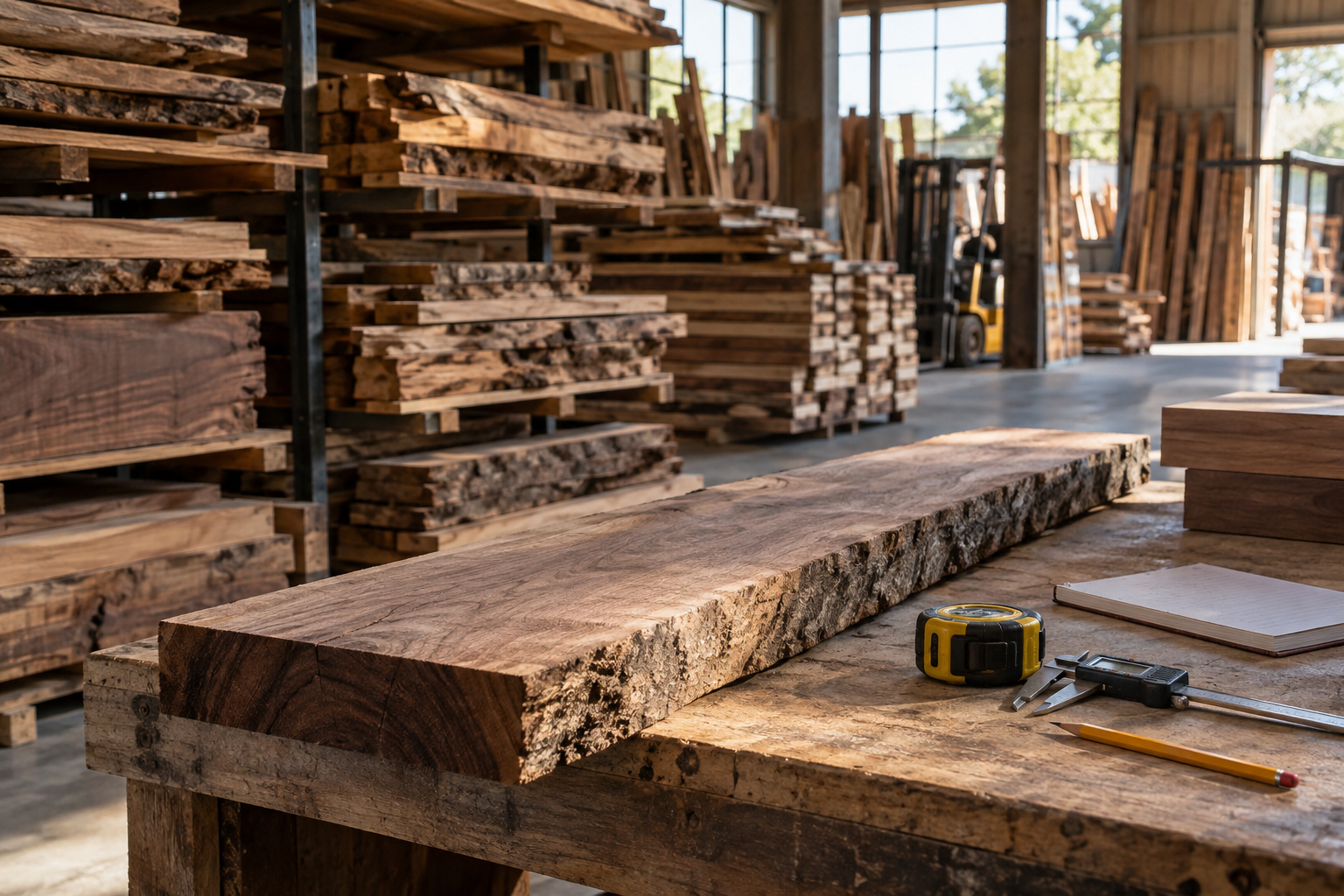
A lumber yard price tag tells you what a board costs only after you identify the pricing unit, billing dimensions, grade, and milling condition. Before comparing prices, ask whether the number is per board foot, linear foot, or piece—and whether surfacing, straight-line ripping, or other charges are included.
Start with the lumber pricing unit
A large $6.40 on a rack sign means little without the small print. These are the units you’re most likely to encounter:
| Tag notation | What you’re buying | What to verify |
|---|---|---|
| BF, BDFT, or $/BF | Board feet: a volume measurement | Thickness, width, and length used for billing |
| LF, LIN FT, or $/LF | Linear feet: length only | Exact board profile and cross section |
| EA, PC, or EACH | One board or item | Dimensions and length included in that price |
| MBF or $/M BF | 1,000 board feet | Whether the quote is retail or wholesale |
| MLF or $/M LF | 1,000 linear feet | Profile, length requirements, and minimum order |
| BUNDLE or LOT | The specified group of boards | Actual contents, defects, and return policy |
Hardwood dealers commonly use board feet. Moldings and some surfaced boards are sold by linear foot. Construction lumber is frequently priced by the piece, although suppliers also use thousand-board-foot quotes.
Don’t treat these as universal rules. The unit printed on the tag—or confirmed by the salesperson—controls the calculation.
Board-foot prices account for thickness and width
One board foot equals a piece measuring 1 inch thick × 12 inches wide × 12 inches long (25.4 × 304.8 × 304.8 mm).
With thickness and width in inches and length in feet:
Board feet = thickness × width × length ÷ 12
Suppose the yard tallies a rough board as 1 inch thick (25.4 mm), 7½ inches wide (190.5 mm), and 8 feet long:
- Volume: 1 × 7.5 × 8 ÷ 12 = 5 board feet.
- At $6.40/BF: 5 × $6.40 = $32.00 before fees and tax.
Use the Board Foot & Lumber Cost Calculator to check several boards without doing the arithmetic beside the rack.
All prices and charges below are illustrative estimates, not current quotes. Species, region, grade, drying, and order size can change them substantially.
Linear-foot prices ignore width and thickness—within that product
An 8-foot board tagged $4.25/LF costs $34.00, regardless of its cross section. That doesn’t mean another width on the next rack has the same rate.
For a finished board measuring ¾ inch × 5½ inches (19.1 × 139.7 mm), its physical volume per linear foot is:
0.75 × 5.5 ÷ 12 = 0.34375 BF
At $4.25/LF, that’s about $12.36 per board foot of finished material. This conversion helps compare identical finished products, but it isn’t a fair direct comparison with rough lumber: the surfaced board already includes machining and material loss.
The Linear Feet & Cost Calculator is useful for adding up trim, edging, and fixed-width boards sold by length.
Decode a hardwood lumber rack tag
Consider this hypothetical sign:
RO — 4/4 — SEL — KD — S2S — RWL — $6.40/BF
Read it as a description plus a price, not as a promise that every board will suit your project.
Species and grade abbreviations
RO commonly means red oak; WO commonly means white oak. Abbreviations aren’t standardized across every dealer, so ask rather than guessing.
SEL generally indicates Selects. Other hardwood tags may show FAS, F1F, or #1 Common. These grades concern the yield of qualifying clear cuttings under grading rules—not simply how attractive the whole board looks.
A higher grade generally makes it easier to obtain larger clear parts. It doesn’t guarantee a straight board, matching color, a particular grain pattern, or zero waste.
For short drawer components, a lower-grade board with well-positioned defects may be economical. For a long, uninterrupted table apron, buying higher-grade stock can save both money and frustration. Also ask about special species rules or proprietary dealer grades; a casual “select” label may need clarification.
Quarter thickness: what 4/4 and 8/4 mean
Hardwood rough thickness is often expressed in quarters of an inch:
- 4/4: nominally 1 inch (25.4 mm).
- 5/4: nominally 1¼ inches (31.8 mm).
- 6/4: nominally 1½ inches (38.1 mm).
- 8/4: nominally 2 inches (50.8 mm).
Those are rough-stock designations, not guaranteed finished dimensions. Relatively flat 4/4 stock often finishes at ¾ inch (19.1 mm), but a badly cupped board may not.
If you need a full 1-inch finished thickness (25.4 mm), don’t assume 4/4 will provide it. Inspect thicker stock and ask what finished thickness the yard can supply.
Drying and milling codes
KD means kiln-dried. AD means air-dried. Neither abbreviation tells you the board’s exact moisture content today; storage conditions matter.
Milling labels commonly include:
- RGH or rough: surfaces remain rough-sawn.
- S2S: surfaced on two faces; edges may remain rough.
- S3S: commonly surfaced on two faces with one straightened edge; confirm locally.
- S4S: surfaced on four sides.
- SLR1E: straight-line ripped on one edge.
- RWL: random widths and lengths.
S4S doesn’t necessarily mean straight enough for your joinery right now. A board can move after machining. Check it rather than paying a premium solely for the label.
Ask which dimensions the yard uses for billing
This is where a correct calculation can still disagree with the invoice.
A surfaced board measuring ¾ inch thick (19.1 mm) may be sold on its original 4/4 tally. That isn’t automatically an overcharge. The dealer bought rough stock, removed material, and priced the product using its stated billing convention.
Ask these questions before selecting boards:
- Is thickness billed as nominal rough thickness or actual thickness?
- Is width measured before or after edge ripping?
- How are fractional widths and lengths rounded?
- Is the price based on a gross tally before drying or a net tally after drying?
- Do I pay for the entire board if I only need part of it?
Drying changes dimensions, and dealers may use different tally bases. Don’t calculate an assumed shrinkage adjustment yourself. Ask for the applicable tally and rate in writing.
For random-width stock, compare your measurements with a sample invoice line. Some yards use grading-rule surface-measure procedures; others use more direct fractional measurements. Small differences aren’t proof of an error, but the method should be explainable.
Nominal construction sizes are a separate convention
A typical dry, surfaced nominal 2 × 4 measures about 1½ × 3½ inches (38.1 × 88.9 mm). If it’s priced per piece, that piece price is what you pay—not a price recalculated from actual board feet.
Keep construction-lumber sizing separate from hardwood quarter-thickness terminology. Both involve nominal dimensions, but they aren’t interchangeable shopping systems.
Compare the total lumber bill, not just the rack price
Two yards can post different board-foot prices and still land at nearly the same checkout total.
For an illustrative 30-BF purchase:
| Charge | Yard A | Yard B |
|---|---|---|
| Lumber | 30 BF × $5.80 = $174 | 30 BF × $6.60 = $198 |
| Surfacing | 30 BF × $0.65 = $19.50 | Included |
| Edge ripping | $12 | Included |
| Total before tax | $205.50 | $198.00 |
This comparison assumes equivalent species, grade, tally basis, and finished result. Without those conditions, the totals aren’t directly comparable.
Small-order milling might be quoted around $0.40–$1.25/BF, or the yard may apply a $20–$60 minimum shop charge. Those are planning estimates only; get the actual schedule.
Other questions worth asking:
- Are wide boards or long lengths priced at a premium?
- Does hand-selecting lumber carry a charge?
- Is a quantity discount limited to full bundles or unselected stock?
- Are crosscuts charged individually?
- Does delivery have a minimum charge?
- Are milled or cut boards returnable?
A discounted bundle isn’t cheap if half its widths don’t fit your parts. Conversely, paying for surfacing can be sensible if it avoids buying equipment you rarely need.
Buy for usable yield, not the lowest price per board foot
The cheapest board is the one that supplies your required parts at the lowest total cost—not necessarily the one with the lowest sticker price.
Consider two hypothetical choices:
- Lower-priced stock: $5.50/BF, with an estimated 60% usable yield.
- Cleaner stock: $7.00/BF, with an estimated 85% usable yield.
Dividing price by expected yield gives a useful comparison:
- $5.50 ÷ 0.60 = $9.17 per usable BF.
- $7.00 ÷ 0.85 = $8.24 per usable BF.
These yield percentages are planning assumptions, not grade guarantees. Use the same thickness basis for both; this shortcut doesn’t automatically account for planing rough boards thinner.
Match board lengths to your cut list
Suppose you need two finished parts, each 48 inches long (1,219.2 mm). An exactly 8-foot board cannot provide both once you allow for saw kerf and end trimming.
With just ½ inch (12.7 mm) of trim at each end and one ⅛-inch (3.2 mm) separating cut, you need at least 97⅛ inches (2,467 mm) of sound length. End checks could require considerably more.
Bring a rough part list showing finished length, width, thickness, and quantity. Mark which parts need clean faces, matched color, or uninterrupted grain. Run likely board sizes through the Cut List & Waste Optimizer, then adjust for the defects actually present.
For reasonably straight, selected rough hardwood, 20–30% extra can be a starting allowance for layout, trimming, and milling. Defect-heavy stock, strict grain matching, or long clear parts can require more. A board-by-board layout is more reliable than any blanket percentage.
Inspect lumber before the yard cuts it
Sight along the edges and faces for bow, crook, cup, and twist. Check both ends for splits, and look for wane where bark or missing wood reduces the usable cross section.
A wide board with severe cup can be a poor bargain: flattening may remove too much thickness. If your project needs narrow parts, ripping before flattening may improve yield—but only with a safe machining plan and suitable stock support.
Ask permission before rearranging a stack. Get help with heavy boards, keep fingers out of pinch points, and don’t climb racks. Gloves help when handling rough lumber; remove them before using rotating machinery where they could catch.
Before checkout, have the yard confirm the piece count, tally, unit price, milling charges, and special premiums. It’s easier to resolve a measurement question while the board is still there.
Common mistakes when reading lumber prices
- Comparing $/LF with $/BF. Convert only after confirming dimensions and milling condition.
- Using surfaced thickness in a nominal-thickness tally. Ask how the dealer bills surfaced hardwood.
- Assuming S2S means jointed flat. Surfaced faces don’t guarantee a flat reference face or straight edge.
- Buying exact finished length. Leave room for kerf, end trimming, and checks.
- Paying for width you’ll discard. A wide-board premium rarely helps when every part is narrow.
- Assuming kiln-dried means ready to build immediately. Check moisture suitability and allow lumber to adjust to your shop.
- Buying before checking the minimum milling charge. A small order can carry a large per-board processing cost.
FAQ
Is hardwood always sold by the board foot?
No. Rough and random-width hardwood commonly is, but surfaced hardwood may be sold by linear foot or piece. Project boards and specialty blanks often have individual prices. Read the unit on each rack.
Why am I charged for 1-inch lumber when it measures ¾ inch?
The yard may sell surfaced 4/4 lumber on its nominal rough-thickness tally. That can be a normal pricing convention, provided it’s disclosed. Ask whether the posted rate includes surfacing and which dimensions appear on the invoice.
Does FAS lumber guarantee a clear, straight board?
No. FAS is a hardwood cutting-yield grade, not a guarantee of straightness, matching color, or a completely defect-free board. You still need to inspect the board and fit your parts around any defects.
Can I buy only half of a long board?
Sometimes. A dealer may cut it and sell the requested portion, require a minimum remaining length, or charge for the whole board. Ask before requesting a cut, especially because cut material may be nonreturnable.
What should I ask before paying for lumber?
Ask: “What is the total for these boards, including the billed tally, milling, cutting fees, and tax?” Then verify the species, grade, thickness designation, and piece count. That single check catches more practical buying problems than arguing over the headline price alone.
What should I read next?
Recommended tools
Digital Angle Gauge
Dial your blade in to 0.1°
View on Amazon →
Laser Tape Measure
Measure long spans solo, fast
View on Amazon →
Titebond III Wood Glue
Waterproof and stronger than the wood
View on Amazon →
As an Amazon Associate we earn from qualifying purchases.
Need ready-to-build plans?
5 complete build plans with cut lists — $14.