Tools · 10 min read
Circular Saw vs. Table Saw: Which First on a Small Budget?
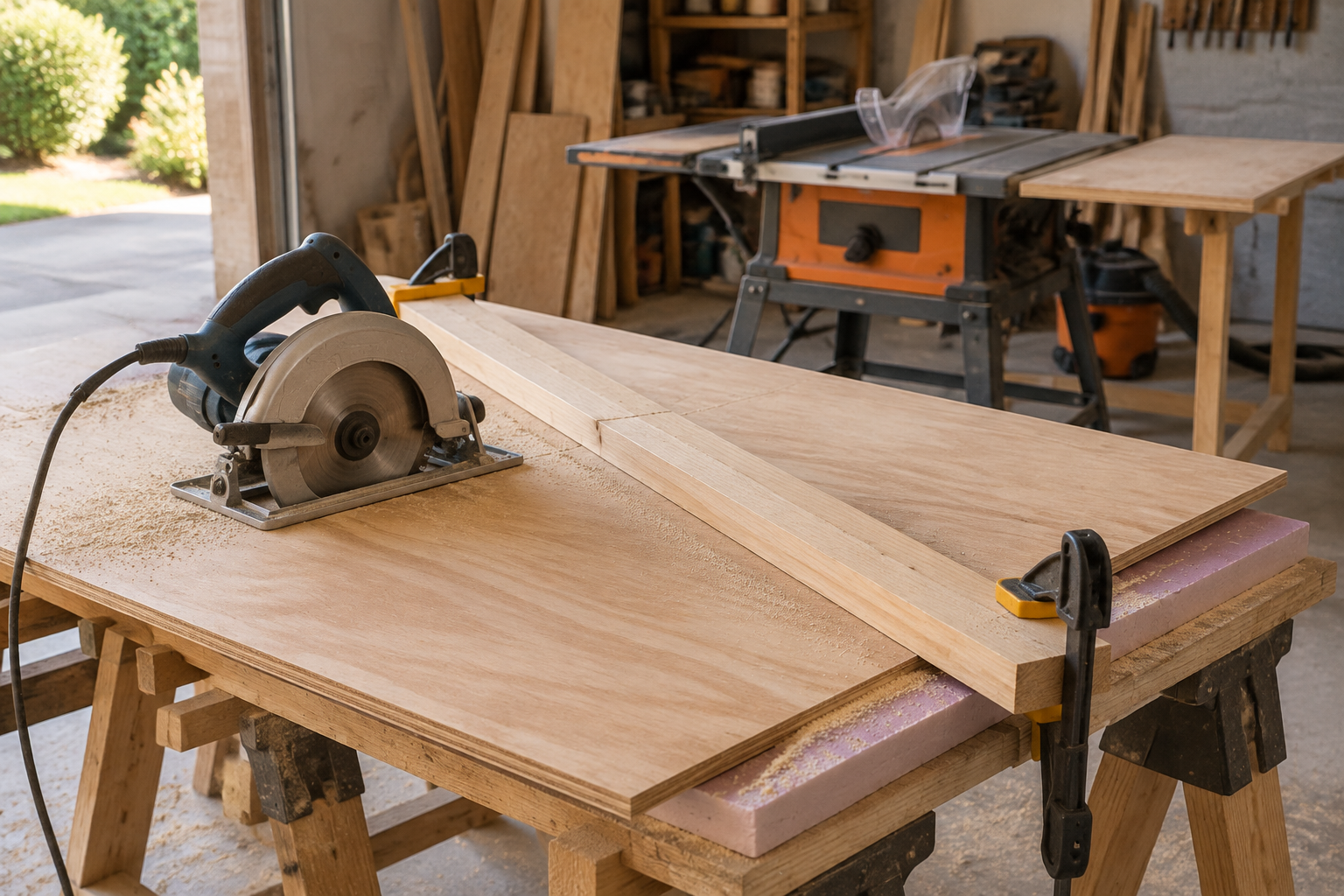
A circular saw is usually the better first purchase on a small budget, especially for plywood projects, occasional repairs, and shops that disappear when the car comes home. Buy a table saw first when most of your work involves repeated, identical-width cuts in manageable boards—and you can afford the support equipment and clear workspace it needs. Compare complete cutting setups, not just the prices on the boxes.
Circular saw vs. table saw: what changes in actual use?
A circular saw moves across stationary material. A table saw stays put while you feed material past its blade. That difference determines which tool feels manageable, which cuts repeat easily, and how much room you need.
Neither is automatically more accurate. A guided circular saw can make excellent straight cuts; a table saw with a fence that shifts when locked can waste expensive lumber.
| Buying consideration | Circular saw | Portable table saw |
|---|---|---|
| Best starting work | Sheet goods, long boards, jobsite cuts | Repeated rips, small cabinet parts, dimensioned lumber |
| Typical budget saw price, estimated | $60–$130 for a corded model | $250–$450 for a basic jobsite model |
| Straight-cut setup | Guide placement for each cut | Fence setting, then repeated feeds |
| Full plywood sheets | Manageable with full support | Awkward without substantial support and suitable rip capacity |
| Narrow strips | Poor choice with a basic handheld setup | Better with appropriate guarding and feeding aids |
| Crosscuts | Good with a properly secured guide | Good with a suitable miter gauge or crosscut sled |
| Storage | Shelf or cabinet | Dedicated floor space or a folding stand |
| Main accuracy bottleneck | Guide placement and saw tracking | Fence alignment and stock control |
The practical question is not which saw does more. It is which saw makes your next three projects easier without using up the material budget.
What a usable starter setup really costs
These are estimated US retail ranges, not quotes. Sales, local used-tool markets, and equipment you already own can move the totals considerably.
Circular saw starter budget: about $145–$310
A useful corded setup might include:
- Saw: $60–$130.
- Material-appropriate carbide blade: $15–$30, if the included blade is unsuitable.
- Clamps and a shop-made straightedge guide: $25–$50.
- Sacrificial support, such as rigid foam over a suitable flat surface: $20–$40.
- Eye, hearing, and dust protection: $25–$60 for a basic allowance; respirator selection can increase this.
A corded saw avoids buying batteries and a charger. Cordless makes more sense when you already own compatible batteries with enough capacity, or routinely work away from outlets.
A common 7-1/4-inch (184 mm) circular saw handles sheet goods and nominal 2-by lumber at a square cut. Check the actual depth specification, especially for bevel cuts, rather than assuming blade diameter tells the whole story.
Table saw starter budget: about $340–$690
A basic setup might include:
- Saw: $250–$450, with its riving knife, guard assembly, fence, and miter gauge.
- Better blade if needed: $25–$50.
- Stable mounting and outfeed support: $30–$90 using a simple shop-made arrangement.
- Push aids: $10–$25 beyond whatever comes with the saw.
- Eye, hearing, and dust protection: $25–$60 as a starting allowance.
These totals exclude a dust extractor and any electrical upgrades. If suitable support or dust control is missing, budget for it rather than treating it as an optional improvement.
An outfeed surface is particularly important: once a long board passes the blade, its weight can tip it off the table and pull your attention away from the cut.
With a hard $200 limit and no existing equipment, the circular saw is generally the sensible purchase. A bargain table saw can still be unaffordable if it needs missing safety components, a stand, and a blade.
Choose based on the cuts you actually make
Plywood shelves and storage boxes favor the circular saw
For garage shelves, utility cabinets, and simple plywood furniture, a circular saw lets you support the sheet and bring the tool to it. That is often easier than steering a full 48-by-96-inch (1,219-by-2,438 mm) sheet across a small table saw.
A clamped straightedge or shop-made saw guide handles long rips and panel crosscuts. Factory sheet edges can be useful references, but inspect them for damage and check squareness before trusting them.
Use the Plywood Sheet Calculator to estimate material needs before buying the saw. If the project needs two sheets, spending an extra $250 on machinery may delay the build more than a slower cutting method would.
Store breakdown cuts can help with transportation. Unless the store guarantees finish-cut accuracy, request oversized pieces and trim them yourself.
Repeated-width parts favor the table saw
Suppose a project needs twelve rails, each 2-1/2 inches (64 mm) wide. On a table saw, you set the fence, make a test cut, and leave the setting alone while ripping the batch.
With a basic circular saw guide, each new layout adds another chance for measurement or clamping error. Repeatability—not necessarily a smoother edge—is the table saw's biggest advantage here.
It also helps when several parts must match closely. A shelf that is slightly narrow may still work; a series of mismatched rails creates extra fitting and sanding.
Rough boards do not automatically favor either saw
Neither saw replaces a jointer or planer. Twisted, bowed, or badly cupped boards need assessment and preparation before accurate sizing.
For ordinary fence-guided table-saw ripping, stock needs a stable face on the table and a straight reference edge against the fence. Do not force a wandering edge against the fence and expect the blade to straighten everything safely.
If your budget assumes cheap rough lumber will immediately become straight furniture parts, include the workholding and milling process—not just a ripping tool.
How accurate can a budget circular saw be?
Accurate enough for many cabinets, shelves, and utility projects, provided the base is sound, the blade is suitable, and the guide does not move.
For general shop storage, keeping finished panel dimensions within roughly 1/32 inch (0.8 mm) is a reasonable working target. It is not a guarantee, and fitted joinery may require tighter control.
Build accuracy into the setup
- Unplug the saw or remove its battery. Check blade condition, base security, and the blade's square setting against the shoe.
- Make a test cut in scrap. Confirm squareness and measure the actual offset between the guide-contact edge of the shoe and the kerf.
- Support the work. Keep both sides of the cut supported without arranging supports that let the kerf close and pinch the blade.
- Secure the guide and material. Check that clamps clear the motor housing and the entire saw path.
- Mark the waste side. Put the blade's kerf in the waste, not down the middle of your finished dimension.
- Let the blade reach speed before entering. Feed steadily without twisting the saw or forcing it through the cut.
A shop-made zero-clearance guide has a sacrificial edge trimmed by your own saw. Align that edge with the cut marks instead of repeatedly measuring the shoe offset. Recheck it after changing blades or altering the saw setup.
For a conventional handheld circular saw, the cleaner face is generally underneath because the teeth exit the upper face. Test your actual blade and material before cutting visible parts.
Plan the cutting sequence with the Cut List & Waste Optimizer, then verify grain direction, kerf allowance, and usable reference edges before cutting.
Small-shop space: measure the cutting path
A compact table saw does not necessarily need a compact working area.
Ripping a 96-inch (2,438 mm) board requires approximately that length of clear travel on both the infeed and outfeed sides of the blade. Plan on roughly 16 feet (4.9 m) of unobstructed cutting travel, plus room to stand and handle the stock.
That clearance can sometimes run through an open garage door. It still needs to be level, stable, and free of cords, stored lumber, and foot traffic.
A circular saw can break down sheets on a fully supported sacrificial surface. Floor-level cutting saves bench space but involves kneeling and reaching; a stable, properly supported raised platform may be more comfortable. Never reach so far that you lose control of the saw.
Before choosing a table saw, also check:
- Rip capacity: A fence limited to 12 inches (305 mm) will not make a 24-inch (610 mm) fence-guided rip in the usual setup.
- Stand stability: The saw should not rock, slide, or tip during feeding.
- Outfeed height: Support should sit slightly below the table, never high enough to catch the workpiece.
- Storage routine: A heavy saw you dread unfolding may get used less than a simple guided circular saw.
Safety equipment is part of the purchase
Both saws can kick back and cause severe injuries. Read the manual and learn the machine's controls before the first cut.
Circular saw safety essentials
Set blade depth according to the manual; for ordinary through-cuts, only a small amount of blade should extend below the stock, commonly about 1/8–1/4 inch (3–6 mm). Make sure the sacrificial support provides clearance beneath it.
Keep the lower guard functioning freely. Never tie it open. Keep hands clear of the underside and cutting path, and never hold a small workpiece in your hand while cutting it.
Wait for the blade to stop before setting the saw down. Manage the cord so it cannot snag or cross the blade path.
Table saw safety essentials
Use the manufacturer-specified riving knife, blade guard, and anti-kickback components for cuts that permit them. The riving knife must be compatible with the blade's kerf and plate thickness.
Never freehand a cut. Use the fence for ripping and a suitable miter gauge or sled for crosscutting. Do not trap a crosscut piece between the blade and rip fence; a fence-mounted length stop must release the stock before it reaches the blade.
Use appropriate push sticks, push blocks, and fixtures, keeping hands out of the blade path. Extremely narrow rips require a suitable method—not simply a smaller push stick. If the setup compromises guarding or hand clearance, stop and choose another approach.
For either saw, use eye and hearing protection, suitable dust collection where practical, and respiratory protection appropriate to the exposure.
Common mistakes when buying your first saw
- Spending everything on the machine. Leave money for support, a suitable blade, protection, and project materials.
- Confusing motor power with accuracy. A stable shoe or reliable fence matters more than an impressive number on the carton.
- Expecting a circular saw to handle tiny parts comfortably. Start with larger, securely supported stock and choose a suitable cutting method before pieces become too small to control.
- Buying a used table saw without its safety hardware. Confirm that exact replacement parts are available and include their cost. Do not assume a generic riving knife will fit.
- Ignoring the fence on a used saw. With power disconnected, check that it locks consistently without shifting and can be aligned according to the manual. Reject damaged mechanisms rather than planning to compensate by hand.
- Counting on a table saw for full-sheet breakdown. A small table and adequate advertised rip capacity do not equal adequate sheet support.
FAQ
Can a circular saw replace a table saw?
For many occasional plywood and construction projects, yes. It becomes less convenient for repeated narrow rips, small parts, and operations that need dedicated fixtures. Buy for the cuts you regularly make, not every cut you might someday attempt.
Is a cheap table saw more accurate than a circular saw?
Not automatically. A guided circular saw can outperform a table saw with a poorly locking fence. The table saw's advantage is reproducing a proven setting without laying out each cut again.
Should I buy a track saw instead?
Consider one if sheet goods dominate your work and the budget allows the saw, track, and support setup. A compatible track simplifies alignment and saw guidance. It still does not turn narrow-stock ripping into the same operation as fence-guided table-saw work.
Is a used table saw a better budget choice?
Sometimes, if it is complete, mechanically sound, and supported with replacement parts. Inspect it unplugged before any demonstration. Missing guards, damaged fences, improvised switches, or unavailable safety components can erase the savings quickly.
When is it time to add a table saw?
When repeated guide setups become your main bottleneck and your projects regularly need matching widths. Keep the circular saw for breaking large sheets into manageable panels. The two tools complement each other; buying the circular saw first does not make it obsolete later.
What should I read next?
Recommended tools
Digital Angle Gauge
Dial your blade in to 0.1°
View on Amazon →
Laser Tape Measure
Measure long spans solo, fast
View on Amazon →
Titebond III Wood Glue
Waterproof and stronger than the wood
View on Amazon →
As an Amazon Associate we earn from qualifying purchases.
Need ready-to-build plans?
5 complete build plans with cut lists — $14.